
Collecting - Antiques - Curiosity

Collecting  - Antiques - Curiosity

SHOP

Featured products

Have a look at our products, if you are interested and need more details contact us!
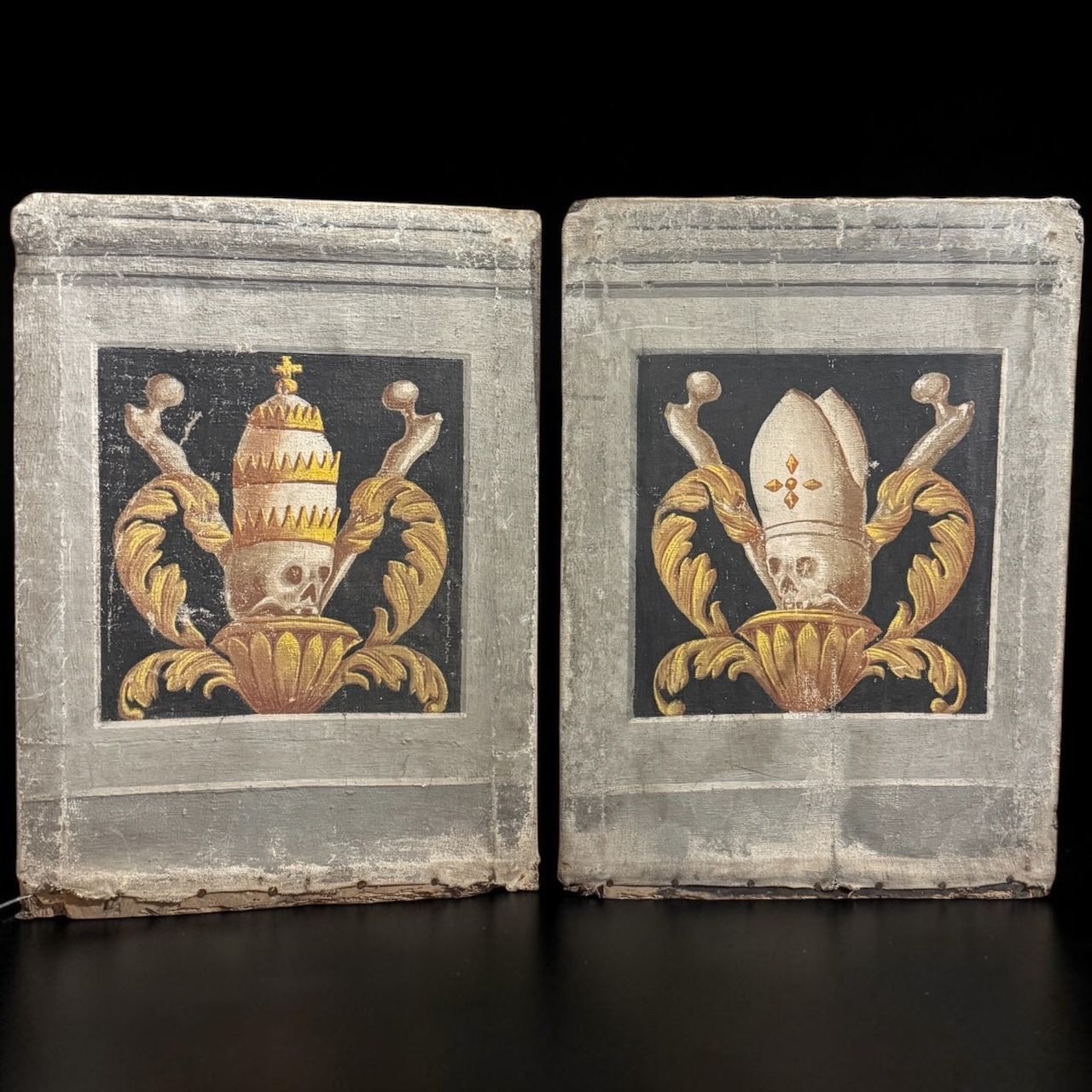
Pair of Vanitas Paintings with Papal Tiara and Episcopal Miter 17th/18th century

€ 4.900,00
In stock: 1 available
Product Details

Make your offer

🚚FREE SHIPPING WORLDWIDE

Pair of Vanitas Paintings with Papal Tiara and Episcopal Miter
A pair of antique oil paintings on canvas, dating from the 17th and 18th centuries, are strikingly iconographic and feature a simple yet powerful subject: a human skull associated with the symbols of ecclesiastical authority.
The two canvases are conceived as a companion piece, and their meaning emerges especially when viewed together.
One of the two compositions features a skull surmounted by the Papal Tiara; in the other, the same skull motif is associated with the Episcopal Miter.
The result is a powerful juxtaposition:
the highest authority of the Church on one side, episcopal authority on the other; above, the symbols of ecclesiastical power; below, the skull.
This is a typical formulation of the culture of Memento Mori and Vanitas, in which the skull recalls the brevity of existence and the inevitable fate of man. The Vanitas theme enjoyed particular popularity in 17th-century European painting, with the skull among its most recognizable symbols.
The Papal Tiara and the Three Crowns
The symbol depicted in the first canvas is particularly important.
The Papal Tiara, or Triregnum, is depicted with its three overlapping crowns. It is therefore not a simple ecclesiastical headdress, but an extremely precise symbol of papal authority.
The Holy See explains that the three crowns represent the Pope's triple power, traditionally expressed in the formula:
"Father of kings, ruler of the world, Vicar of Christ."
The same tradition has also interpreted the three crowns as a reference to the Church Militant, the Church Suffering, and the Church Triumphant.
It is precisely the presence of the Triregnum above the skull that makes this composition particularly significant.
The symbol of the Church's highest earthly authority is placed directly next to the universal symbol of death.
Power over the skull.Authority over transience.Earthly glory in the face of death.
The second canvas takes up the same concept through the episcopal miter, creating a dialogue between two different levels of ecclesiastical authority.
A deliberately powerful image
These works clearly do not seek to represent a portrait or a specific character.
Their language is allegorical and symbolic.
The skull does not identify a person: it represents man in his mortal condition.
The Tiara and the Miter, on the other hand, represent authority, dignity, and ecclesiastical hierarchy.
Their superposition thus produces an immediate and universal message:
in the face of death, every man is equal.
It is precisely this simplicity of the image, combined with the complexity of its meaning, that makes the pair so interesting.
The decoration
Both compositions are characterized by a dark background, against which the skulls and ecclesiastical headdresses stand out clearly.
On the sides and around the figures, scrolls and ornamental plant motifs develop, giving the composition a particularly rich decorative feel.
The contrast between the dark background, the light tone of the skulls, and the decoration also contributes to the particularly severe and meditative atmosphere typical of Memento Mori images.
The back: an important part of the history of the works
An element that deserves particular attention is the back of the canvases.
On the back, the old canvas, the wooden stretchers, the tensioning system, and numerous traces of fastening are clearly visible, along with the marks left by time and subsequent conservation treatments.
There are also handwritten notes, numbers, and other markings on the back, including the wording you identified as "Towards the door."
This note is interesting precisely because it pertains to the material history of the works: it could be linked to their previous location or arrangement, but without a direct examination of the artifact, it would be incorrect to attribute a more precise meaning to it.
And that's precisely the point: there's no need to invent an explanation to give value to that inscription.
The fact that it remained on the back of a pair of antique canvases already provides evidence of their history, their movements, and the way they were preserved or displayed over time.
The back, therefore, also becomes an integral part of the interpretation of the work.A pair, not simply two canvases
The value of these paintings lies above all in their unity.
Separately, they are two images of Memento Mori; together, they construct a much more precise discourse.
Papal Tiara and Episcopal Miter.Pope and Bishop as levels of ecclesiastical authority.And beneath both, the same skull.
A composition that directly connects power and death, authority and transience, earthly glory and human destiny.
The choice of the skull as a common element in the two canvases further reinforces the pair's nature as a pendant.
Works of this kind belong to that European figurative culture in which the Memento Mori was not simply a macabre image, but a tool for reflection on the precariousness of existence and the vanity of earthly ambitions.
A pair of great character, rare for the subject matter and particularly interesting for the combination of ecclesiastical iconography, Vanitas symbolism, and the presence of ancient traces preserved on the back.


TECHNICAL DATA


Period: 17th–18th century

Technique: Oil on canvas Subject: Vanitas / Memento Mori

Iconography: Skull with Papal Tiara and Skull with Episcopal MiterType: Pair of pendant paintings

Dimensions: 76 × 55 × 3 cm each (30" x 21.5" x 1.2")

Distinguishing features: Triple-crowned tiara, Episcopal miter, scrollwork, dark background, old annotations and traces of processing and conservation on the back


Save this product for later
Share this product with your friends
Pair of Vanitas Paintings with Papal Tiara and Episcopal Miter 17th/18th century

We collaborate with international auction houses, industry colleagues and international fairs.

The decennial experience in the qualitative field in the commercial sector has allowed us to be among the first in the antiques sector to enter the web world at an international level, always trying to obtain the complete and maximum satisfaction of the final customer.

Find out more about us

Via Boccaccio 8/A, Ghedi 25016 (BS) - ItaLy

We are always looking for curious interesting objects to offer to our customers.

If you have items similar to those we sell and you want to offer them, contact us without obligation, send us photos and we will be happy to answer you and give you all the necessary information.

Contact us

News

Stay up to date on the latest news